Political History of North Korea | Korean War Aftermath
The Political History of North Korea is known at its initial stages for having emphasised its policy of rapid reconstruction of the country, which, like South Korea, suffered heavily in the first armed conflict of the Cold War.
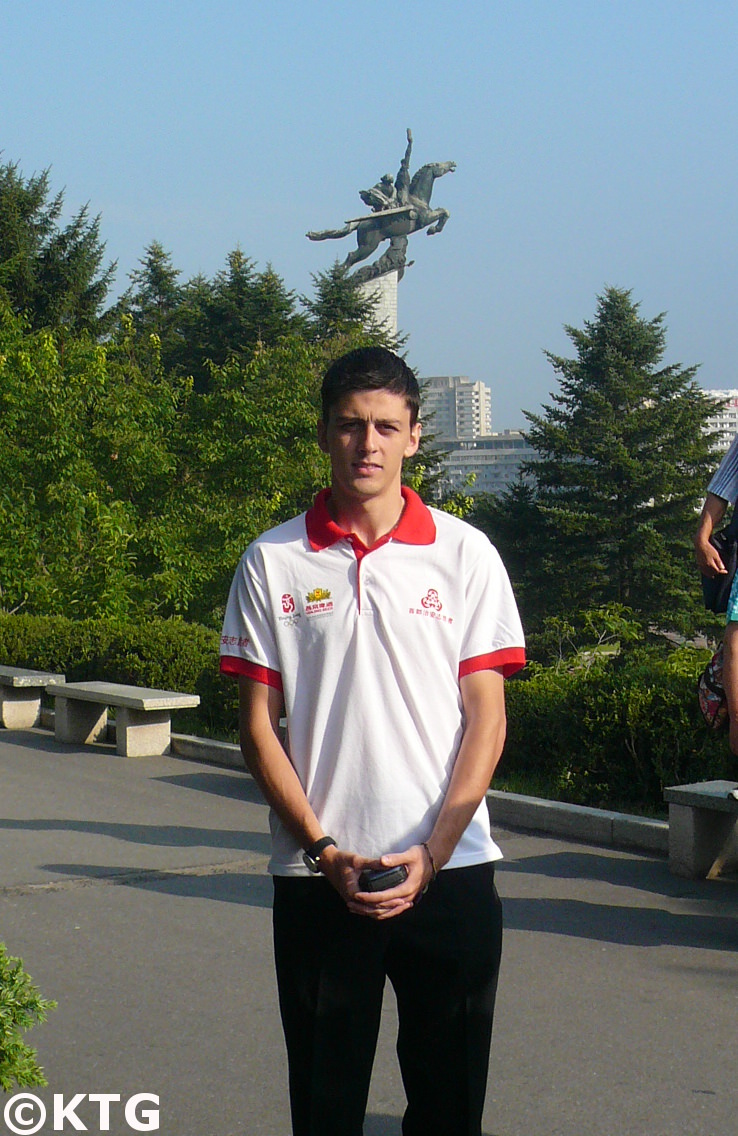
The years following the Korean War, the North Korean government carried out its "Chollima policy". Chollima is the mythical Korean Pegasus that could fly 1000 ri a day but struggled to find someone to ride it. After the War the DPRK used the "Chollima Policy" to encourage people to produce and innovate more in order to speed up the reconstruction of the country. If other countries moved a step forward, North Koreans were asked to move 10 steps forward and in this way the country was rebuilt from scratch.
The Northern part of the Korean peninsula, the DPRK, concentrated its economy on heavy industry in the years following the War and it economically actually outperformed its southern counterpart until the early 1970s.
President Kim Il Sung developed North Korea's own line of thinking, Juche, which stresses the importance of self-reliance and man as the centre of his destiny. This idea was also reflected in the DPRK's foreign policies, where North Korea would have friendly relationships with communist giants, namely the USSR and China, but always keeping them at a certain distance. Thus North Korea never became a satellite power of the Soviet Union and in times of tension between China and the USSR maintained friendly relations with the two countries.
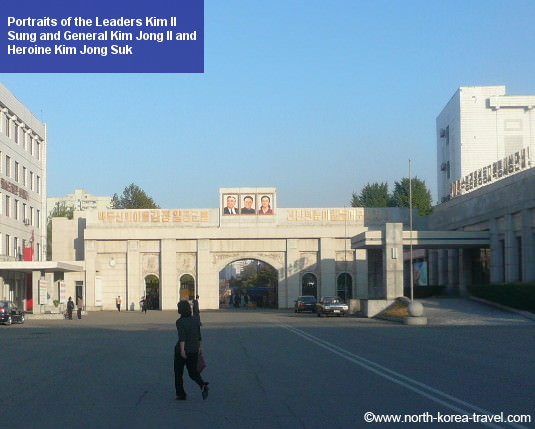
Portraits of President Kim Il Sung, General Kim Jong Il and Heroine Kim Jong Suk (also referred to as Mother Kim Jong Suk)
President Kim Il Sung was referred to as the Great Leader and, after his passing in 1994, named Eternal President of the DPRK. Monuments, statues and portraits of him being present all over North Korea. During the 1970s, Chairman Kim Jong Il started to play an increasingly important role in North Korea's internal politics and propaganda.
Related articles:
The History of North Korea | KTG® Tours | South Korean leaders visit North Korea (DPRK)
The history of North Korea 2000s | KTG® Tours | saw two unprecedented events, that of South Korean presidents crossing the demarcation line and visiting the DPRK. Pyongyang has hosted Kim Dae-jung & Ro
North Korean History 1980s & 1990s | KTG® Tours
North Korean History during the 1980s & 1990s | KTG® Tours| Fall of the Soviet Union. Leader Kim Jong Il who succeeds his father President Kim Il Sung in 1994. North Korea's Juche philosophy of self-reliance and the fall of the soviet block
History of North Korea | KTG® Tours | Liberation of Korea from Japan. Travel to North Korea
History of North Korea | KTG® Tours | Liberation of Korea from Japan. President Kim Il Sung led the struggle against the Japanese from 1925 - 1945. This is when the history of North Korea (DPRK) starts.
Please click on our Koryo page to read about this period preceding the Choson Dynasty. Or see information about the incident that occurred in 1968 between the DPRK and the US known as the USS Pueblo Crisis being an important part of the international political history of North Korea.